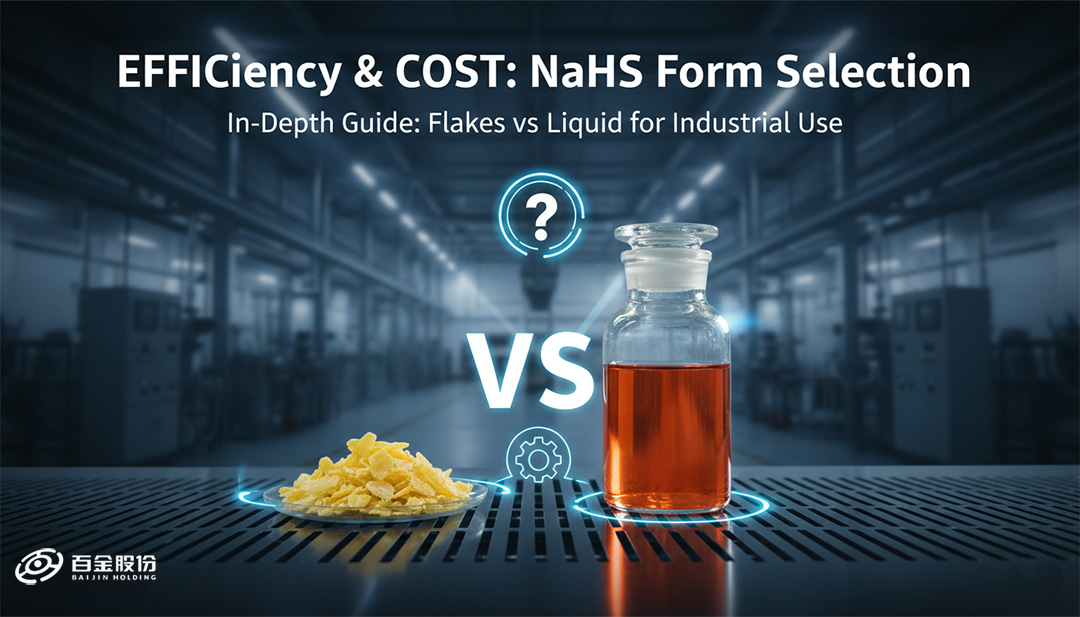
NaHS Selection Guide: 70% Flakes vs. 32%-48% Liquid Solution
As an experienced specialist in the sulfur chemical industry, Baijin Chemical understands that selecting the optimal Sodium Hydrosulfide (NaHS) grade is not merely a procurement decision, but a critical engineering factor influencing flotation recovery rates and leather fiber integrity. With a stable annual production capacity of 40,000 tons at our Shandong Jindian facility and over 30 years of hazardous chemical management expertise, we provide the technical clarity required to navigate the complexities of NaHS specifications in 2026. This comprehensive guide serves as an industrial wiki for engineers and procurement heads seeking to optimize their supply chain and operational efficiency.
1. The Chemical Blueprint: Understanding NaHS Molecular Stability
Sodium Hydrosulfide (NaHS) is a versatile chemical reagent, but its efficacy is highly dependent on its physical state and purity. In the 2026 industrial landscape, purity isn't just a number—it’s a measure of process predictability.
- Solid Flakes (70% Min): The industry standard for long-distance export. By concentrating the active sulfide ion into a solid form, we effectively reduce the transport of water. Our production process in Shandong utilizes high-purity hydrogen sulfide tail gas, ensuring that the residual iron (Fe) content is kept below 10-20ppm, which is critical for sensitive mineral flotation.
- Liquid NaHS (32%-48%): Often preferred by regional operations. While it simplifies the dosing process, it requires specialized storage tanks to prevent crystallization, especially in climates where temperatures drop below 20°C.
2. Deep Dive: Why 70% Purity is the "Golden Ratio" for Export
For a Dedicated Manufacturer like Baijin Chemical, achieving a consistent 70% min purity in solid flakes involves a precise evaporation and cooling cycle.
- Logistics Optimization: Shipping 70% purity flakes instead of 40% liquid means you are not paying for the international freight of water. For a mining site in the Copperbelt of Africa or the Andes in Chile, this equates to a 40% reduction in landed cost per active unit of sulfide.
- Storage Longevity: Solid flakes are more stable over 6-12 month horizons if stored in UV-protected, moisture-proof packaging. In contrast, liquid NaHS can degrade or precipitate over time, leading to inconsistent dosing.
3. Application Spectrum: Mining Flotation & The Depressant Logic
In the recovery of Copper (Cu) and Molybdenum (Mo), NaHS acts as a critical depressant for iron sulfides (pyrite).
- The Dosage-Recovery Correlation: In 2026, as global ore grades decline and impurities rise, the stability of NaHS becomes the anchor of the flotation circuit. Our experienced specialists highlight that consistent 70% min purity eliminates the "reagent drift" common with sub-standard suppliers. For a high-capacity mill (e.g., 50,000 TPD), maintaining chemical equilibrium is not just about chemistry—it is about protecting the bottom line against unpredictable recovery drops.
- Baijin's Technical Advantage: By providing a stable 70% flake, we enable flotation managers to calibrate their automated reagent feeders with 99.9% precision, ensuring that the "depressing" effect is localized exactly where needed without over-dosing.
4. The Leather Industry: Precision Dehairing
The leather tanning sector requires NaHS for the destruction of hair follicles without damaging the delicate collagen structure of the hide.
- pH Buffering: NaHS provides a more controlled alkalinity compared to Sodium Sulfide (Na2S). Our Experienced Specialist team recommends the 70% flake for tanneries focusing on high-end automotive or luxury fashion leathers, where grain consistency is paramount.
- Sludge Reduction: High-purity NaHS results in less chemical sludge in the wastewater treatment plant, directly lowering the "Environmental Compliance Cost" which has become a major burden for tanneries in 2026.
5. Safety, Logistics, and the "Baijin Standard"
Handling NaHS requires a deep reverence for safety. As a Dedicated Manufacturer, we don't just sell chemicals; we export safety protocols.
- H2S Mitigation: In the presence of acids or even moist air, NaHS can release Hydrogen Sulfide (H2S) gas. Our packaging utilizes multi-layer reinforced bags with a specific moisture barrier to prevent premature reaction during maritime transit.
- The 40,000-Ton Resilience: Why does scale matter? Because in the chemical world, scale equals stability. Our integrated supply chain at Shandong Jindian means we control the raw material (Sulfur) all the way to the finished NaHS flake. This 40,000-ton annual output acts as a buffer for our partners against global market volatility.
6. Environmental Sovereignty: The 99.98% Recovery Metric
In 2026, "Green Chemicals" are no longer optional. Baijin Chemical’s production line is a closed-loop system. We capture hydrogen sulfide tail gas from our Carbon Disulfide (CS2) production to synthesize our NaHS. This achieves a total sulfur recovery rate of over 99.98%. When you source from Baijin, your ESG (Environmental, Social, and Governance) report reflects a partnership with a manufacturer that prioritizes the circular economy.
7. Conclusion: The Strategic Procurement Choice
Choosing between solid and liquid, or between 60% and 70% purity, is a balance of logistics, technology, and sustainability. For the global B2B buyer, the "Baijin Standard" provides a low-risk, high-authority path to operational excellence.